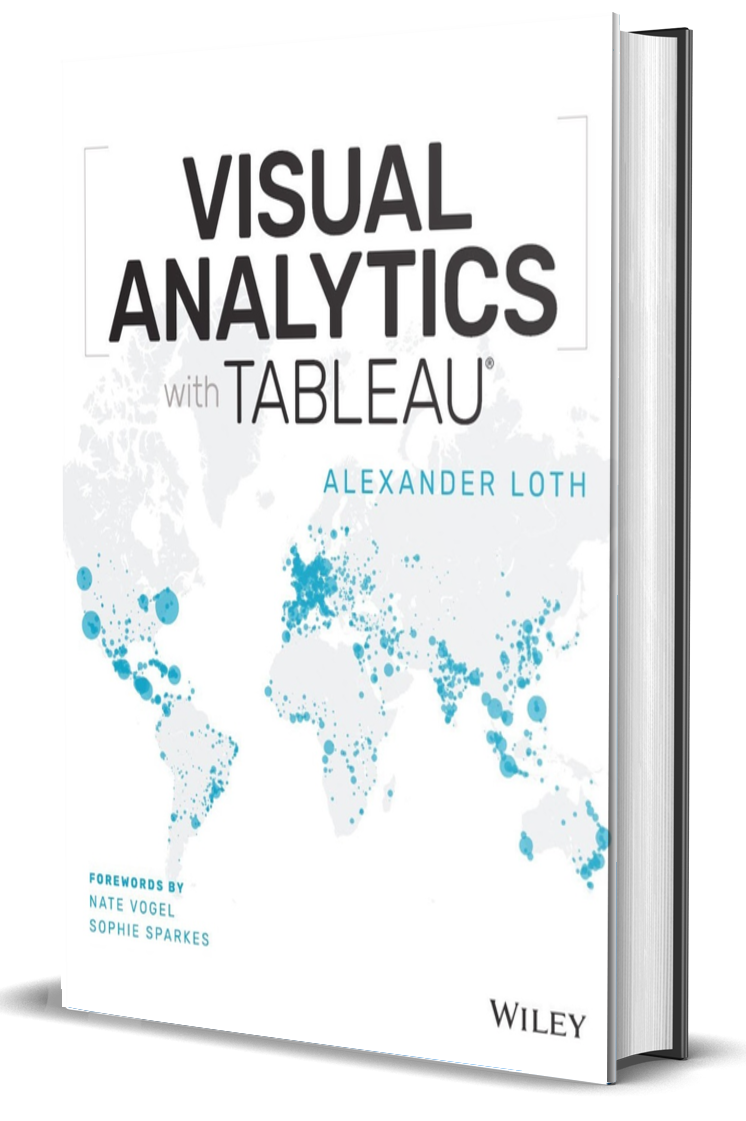
About the Book
Tableau is a popular data visualization and analytics tool favored by financial analysts, marketers, statisticians, business and sales professionals, data scientists, developers, and many others who need to explore insights and present visual, easy-to-understand data. Visual Analytics with Tableau is an accessible, step-by-step introduction to the world of visual analytics. This up-to-date guide is ideal for both beginners and more experienced users seeking a practical introduction to the fields of data analysis and visualization. Through hands-on examples and exercises, readers learn how to analyze their own data and clearly communicate the results.
This guide covers everything you need to get started with Tableau, from the first steps of connecting to data, creating different types of charts, and adding calculation fields to more advanced features such as table calculations, forecasts, clusters, and R, Python, and MATLAB integration for sophisticated statistical modelling. User-friendly instructions for existing options within the Tableau ecosystem—Tableau Desktop, Tableau Prep, Tableau Server, Tableau Online, and Tableau Public—enable you to integrate, clean, and prepare your data and share your work with others.
Why this Book?
Visual Analytics with Tableau:
- Covers the newest versions of Tableau 2018.3 and 2019.1 plus Tableau Prep, Tableau’s brand-new data integration application
- Requires no background in mathematics nor any programming experience
- Focuses on the visual analytics functionality of Tableau rather than complex statistical programming
- Offers expert guidance from popular Tableau Germany employee and visualization expert Alexander Loth
- Discusses advanced Tableau functionality and working with different data structures
- Provides easy-to-follow instructions, full-color illustrations, learning tools, online resources, and more
Content
- Chapter 1: Introduction and Getting Started with Tableau
- Chapter 2: Adding Data Sources in Tableau
- Chapter 3: Creating Data Visualizations
- Chapter 4: Aggregate Functions, Calculated Fields, and Parameters
- Chapter 5: Table Calculations and Level of Detail Calculations
- Chapter 6: Maps
- Chapter 7: Advanced Analytics: Trends, Forecasts, Clusters, and other Statistical Tools
- Chapter 8: Interactive Dashboards
- Chapter 9: Sharing Insights with Colleagues and the World
- Chapter 10: Data Preparation with Tableau Prep
About the Author
Alexander Loth is a digital strategy executive advisor with background in computational nuclear research. For more than twelve years he has advised many large companies in their transformation as they become digital organizations. Since 2019 he has been with Microsoft as executive advisor.
Alexander has an MBA from the Frankfurt School of Finance & Management, where he is also lecturer on the subject of the digital society. Prior to working for Microsoft, he worked for Tableau (now part of Salesforce), for Capgemini, for SAP, and at the European Organization for Nuclear Research (CERN).
Furthermore, Alexander studied at the China Europe International Business School (CEIBS) in Shanghai and was postgraduate researcher at the University of the West of England’s department of computer science. His research focused on machine learning algorithms for geo-distributed petabyte-scale big-data processing.
A co-founder of fin-tech advisory Futura Analytics, Alexander has written and spoken extensively on topics such as digital transformation, artificial intelligence, blockchain, and business analytics. Alexander is the author of the best-selling books Datenvisualisierung mit Tableau, Visual Analytics with Tableau, and Decisively Digital.
Endorsements
If you’re keen to go from beginner to expert in Tableau, Alexander’s excellent book gives you everything you need to know. With a crisp and clear style, he talks the reader through all aspects of Tableau, from data cleaning through data analysis and into sharing insight with others.
—Andy Cotgreave, Author of Big Book of Dashboards and Technical Evangelist at Tableau Software
If you’re getting started with visual analytics and Tableau, this book will teach you everything you need to know to build the foundations and understand how and why to explore your data visually. Alexander has created a fantastic resource that guides you step by step through the process of preparing your data, using Tableau Desktop to analyse it and finding insights. He helps you deliver your message with clarity by applying best practices for data visualisation and takes you through the dashboard building process. Put this book on your desk as your own personal companion for your journey into and through the world of data.
—Eva Murray, Head of BI and Tableau Zen Master at Exasol
Visual Analytics with Tableau – an easy to understand book by Alexander Loth, one of Tableau’s very first employees based in Germany, a recognized speaker on countless conferences, and a Tableau Jedi. It contains both the basics and advanced Tableau features. If you ask me: there is nothing more you need to get started with Tableau!
—Klaus Schulte, Professor at Münster School of Business & 2019 Tableau Zen Master